The moment usually arrives quietly. Your weekend baking orders are now regular. A client asks for a proper bill with a PAN on it. Your Facebook page shop is doing enough that a friend says, "you should register that." A hobby or side hustle has quietly turned into income, and now the paperwork matters — because invoicing clients, opening accounts in the business name, and filing tax all depend on being registered.
Here's the reassuring part: for a one-person business, registration in Nepal is cheaper and simpler than most people fear. A sole proprietorship — legally a "private firm" — is the lightest structure there is, and getting a PAN is free. This guide walks through the structures, the documents, the cost, the PAN, and the point at which VAT enters the picture, in plain language.
Business structures in Nepal (pick the lightest one that fits)
Before you register anything, know which of the three common structures you're actually choosing.
| Structure | Owners | Liability | Best for |
|---|---|---|---|
| Sole proprietorship (private firm) | One | Unlimited (personal) | A single owner starting small |
| Partnership | Two or more | Unlimited, shared | Two-plus co-owners, informal |
| Private limited company | One or more shareholders | Limited to the company | Businesses raising money or limiting personal risk |
For most first-time founders, freelancers going formal, and small local businesses, the sole proprietorship is the right starting point: least paperwork, lowest cost, simplest tax. Its one real downside is unlimited liability — the business's debts are legally your personal debts, because there's no separate legal entity. If your business will take on significant debt or risk, that's the reason to consider a company instead (which is a more involved registration than this guide covers).
Sole proprietorship (private firm): the requirements
A sole proprietorship in Nepal is registered as a private firm under the Private Firm Registration Act. The core requirements are straightforward (as of 2026 — verify the current rules with the Office of the Company Registrar / relevant department and the Inland Revenue Department):
- The owner must be a Nepali citizen.
- The owner must be at least 16 years old.
- One owner only (that's what makes it a sole proprietorship).
- The owner carries unlimited liability for the firm.
You'll also need a business name (check it's available and not misleading), a business address, and the nature of the business decided in advance, because these go on the registration.
Step-by-step: registering the firm
The exact office depends on the type and scale of your business — small trading/service firms typically register with the relevant local department (for example, the Department of Cottage and Small Industries or the ward/municipal authority for very small firms), while some are handled through the Office of the Company Registrar. Confirm the correct authority for your business type before you start.
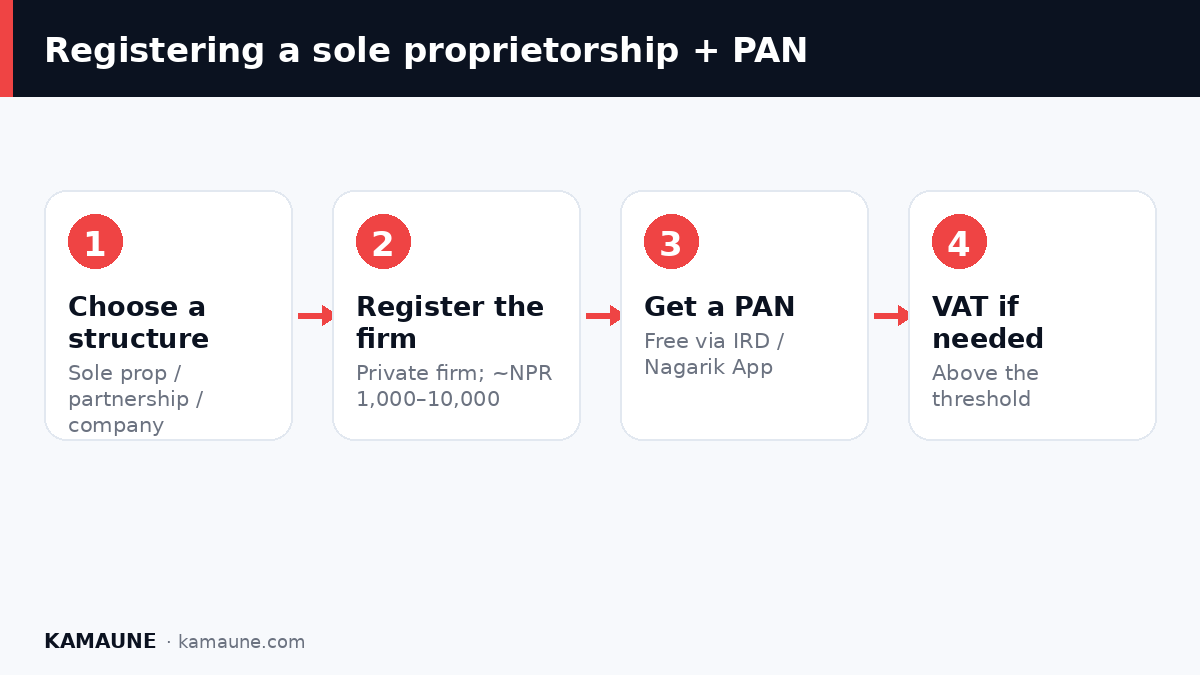
A typical process looks like this:
- Choose and check your business name. Make sure it's available and permitted for your line of work.
- Gather documents — citizenship certificate, passport-size photos, proof of business address, and the application form for the relevant authority.
- Submit the registration application to the correct office with the fee.
- Receive your firm registration certificate.
- Register for a business PAN with the IRD (next section) — this is the step that makes you tax-ready.
- Get any business-specific license your trade requires (food, health, etc.).
Registration cost is typically in the range of NPR 1,000–10,000, depending on the business type and any licenses involved (as of 2026; verify current fees with the registering authority). Offline processing generally takes longer than online.
Getting a PAN (this part is free)
PAN — the Permanent Account Number — is your tax identity. Under the Income Tax Act 2058, a business PAN is required to operate formally and file taxes.
- Cost: free.
- How: through the IRD online portal or the Nagarik App (or in person at an IRD/tax office).
- Time: roughly 3–5 working days when done online, and about 7–10 days offline (as of 2026 — verify the current process and timelines with the IRD).
- What you'll need: citizenship, photos, business/firm details, and your registration certificate.
Once you have a business PAN, you can issue proper invoices, open a bank account in the business's name, and file your income tax returns.
When you also need VAT
PAN is not the same as VAT. Value Added Tax registration becomes mandatory once your business crosses a turnover threshold, and it's also required outright for certain categories of business regardless of turnover.
The threshold and the list of businesses that must register for VAT from day one change over time, so verify the current VAT threshold and rules with the IRD before assuming you're exempt. Registering for VAT when you don't need to adds filing obligations; failing to register when you're required to is a compliance problem. When in doubt, ask the IRD or an accountant.
Freelancer? An individual PAN may be enough
If you're a solo freelancer earning from clients or platforms, you often don't need to register a firm at all to start — an individual PAN can be enough, and you register a firm only when your income becomes consistent and significant, or when a client requires it.
The tax mechanics for freelancers — individual PAN, how foreign-service income is treated, record-keeping, and when to graduate to a registered firm — are covered in detail in tax for freelancers in Nepal. If freelancing is your path in the first place, start with our guide to freelancing in Nepal, which covers finding clients and getting set up.
Where registration fits in your money picture
Registering is one line item in running a business well — the others are pricing, bookkeeping, saving for tax, and separating business money from personal money. If you're building the wider system around your income, our personal finance guide for Nepal covers budgeting and managing money in a way that scales with a business.
And if you're still deciding what to register — the idea itself — see low-investment small business ideas in Nepal for options grouped by capital and skill.
Frequently Asked Questions
How much does it cost to register a business in Nepal?
For a sole proprietorship (private firm), registration typically costs somewhere in the range of NPR 1,000–10,000 depending on the business type and any licenses, as of 2026. The PAN itself is free. Verify current fees with the registering authority and the IRD before you budget.
Is PAN registration free in Nepal?
Yes — obtaining a PAN is free, whether you apply online through the IRD portal / Nagarik App or in person. Online applications typically process in about 3–5 working days; offline can take longer (verify current timelines with the IRD).
Sole proprietorship or a company — which should I choose?
A sole proprietorship (private firm) is simpler and cheaper, but you carry unlimited personal liability for the business's debts. A private limited company limits your liability to the business but involves more paperwork and cost. Most small, single-owner businesses start as a sole proprietorship and reconsider only if they take on significant risk or investment.
Do freelancers need to register a business in Nepal?
Not necessarily to start — a solo freelancer can often operate with an individual PAN and register a firm only when income is consistent and significant, or when a client requires it. See freelancer tax in Nepal for the full picture.
Conclusion
Registering a small business in Nepal comes down to three moves: pick the lightest structure that fits (usually a sole proprietorship), register the firm for a modest fee, and get your free PAN so you're tax-ready. Add VAT only when the threshold or your business type requires it. Do it once your income is real, and it stops being intimidating and starts being routine.
Get the PAN, keep clean records from day one, and you've removed the single most common excuse people use to avoid going legal.
Not sure what to start yet? Browse low-investment small business ideas in Nepal, and join the Kamaune newsletter for practical money and business guidance for Nepal each week.
This article is educational, not financial or legal advice. Rules, rates, and fees change — verify with the relevant official source (IRD, Office of the Company Registrar, or the registering authority) or a qualified professional before acting.