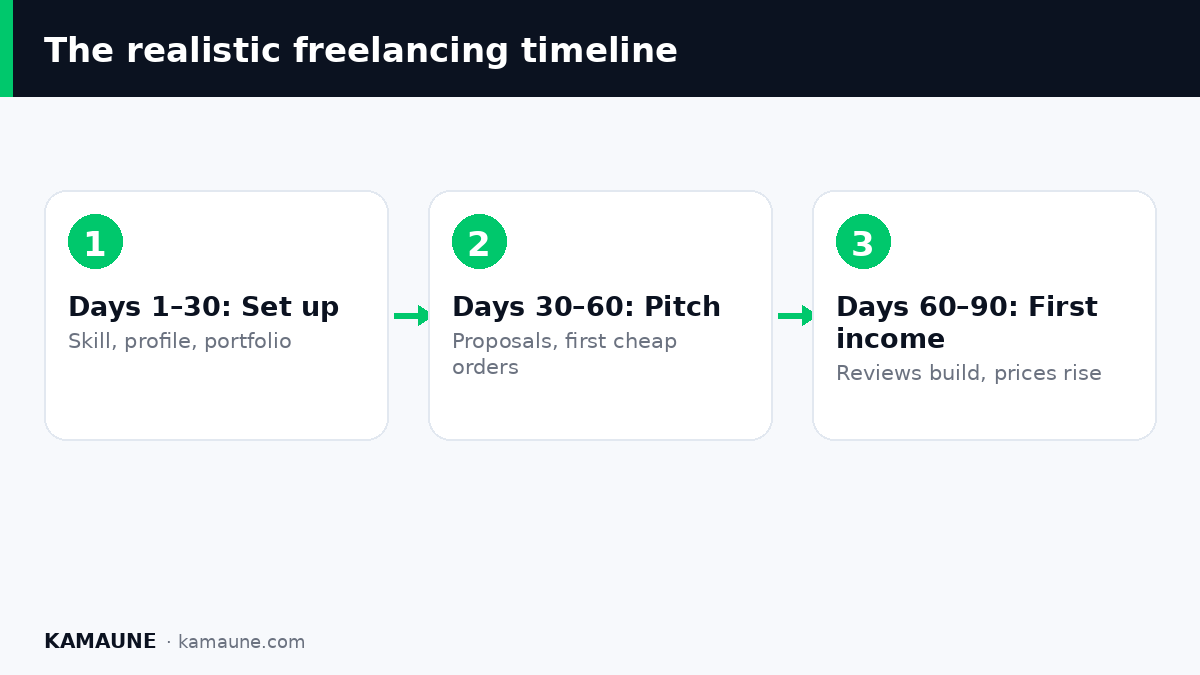
If you start freelancing today and expect a paycheck next week, you'll probably quit by Friday. Here's the timeline nobody sells you: most Nepali freelancers who actually make it see their first real income around 60 to 90 days in. The first two months are learning, setting up a profile, sending proposals into silence, and doing a couple of cheap orders to earn your first reviews. That's not failure — that's the on-ramp everyone drives.
Knowing that up front changes everything. It turns "why isn't this working?" into "I'm on day 40, this is normal." So let's walk the whole path — what freelancing really is, which skills sell, where to find work, how to price it, and how the money reaches your bank — with realistic expectations baked in.
What freelancing actually is (and what it isn't)
Freelancing means you sell a service directly to clients, project by project, instead of drawing a salary from one employer. You're the worker, the salesperson, and the accountant. You choose clients, set rates, and carry the risk of dry months — in exchange for flexibility and, eventually, higher earning potential than most local salaries.
It's worth separating three things people mix up:
- Freelancing — many clients, per-project, you run the show (Fiverr, Upwork, direct clients).
- A remote job — one employer, salary, fixed hours, just done from home.
- A side hustle — freelancing done part-time around a job or classes.
This guide is about freelancing. It's the most common of the many ways to earn money online in Nepal because it pays faster than building an audience and needs no capital — only a skill.
The skills that actually sell
You don't need to know everything. You need one skill that clients pay for, done well enough to deliver. As of 2026, these are consistently in demand and reasonably well paid for Nepali freelancers:
| Skill | Typical starting point | Demand |
|---|---|---|
| Web development (React/Next.js, WordPress) | Build small sites/features; strong GitHub or live demos | High |
| Graphic & logo design | Logos, social creatives, brand kits; portfolio-led | High |
| Video & motion editing | Short-form edits, YouTube editing, motion graphics | High and growing |
| SEO & content writing | Articles, blog posts, keyword research | Steady |
Starting rates are low for everyone at first — that's the review-building phase, not your real value. What decides your income long-term is skill depth plus reviews, not which skill you pick. Choose the one you can practise daily without hating it.
Where to find freelance work from Nepal
There are four realistic sources of clients:
- Fiverr — clients come to you via a "gig" you list. Great for beginners because you're not chasing anyone. We have a full step-by-step: how to start freelancing on Fiverr in Nepal.
- Upwork — you send proposals to posted jobs. More competitive, but bigger contracts.
- Toptal and premium networks — for experienced, vetted freelancers; not a beginner's first stop.
- Local and direct clients — Nepali businesses, agencies, and referrals. Often the most stable income once you have a reputation.
Beginners usually get traction fastest on Fiverr, then add Upwork and direct clients as their portfolio grows.
Building a profile and portfolio with no experience
The classic trap: "I can't get work without experience, and I can't get experience without work." You break it by manufacturing proof.
- Do 2–3 practice projects for imaginary or real (free/discounted) clients and treat them as portfolio pieces.
- Show the result, not the resume — a designer shows designs, a developer shows a live site, a writer shows published or sample articles.
- Write a specific profile — "I build fast WordPress sites for small businesses," not "hardworking passionate professional."
- Use a clear photo and real name — trust is everything when a stranger abroad is about to pay you.
A small, focused portfolio beats a long, vague one every time.
Pricing: why your first orders are cheap on purpose
New freelancers have no reviews, and reviews are the currency of trust on these platforms. So the standard move is to price your first orders low — sometimes just $5–10 on Fiverr — specifically to win a handful of happy clients and 5-star ratings. Once you have social proof, you raise prices in steps.
Think of those first cheap orders as paid marketing, not your real rate. The freelancer charging $5 in month one and $50 in month six is the same person — the reviews changed, not the skill overnight.
How much can you actually earn freelancing in Nepal?
The honest answer: it ranges from pocket money to a full-time income, and anyone quoting a fixed number is guessing or selling something. Your earnings depend on your skill, your reviews, how many hours you put in, and the type of clients you attract — not on which city you live in.
What's realistic to expect as a pattern, not a promise:
- Months 1–3: little to nothing while you build a profile, portfolio, and your first cheap-but-glowing reviews.
- Months 3–6: small but steadying income as reviews accumulate and you raise prices in steps.
- Beyond 6 months: for those who stay consistent and improve their skill, freelancing can match or exceed a typical local salary — and higher-skill work (web development in particular) sits at the top end.
Two people with the same skill can earn very differently based purely on consistency and how well they present their work. Treat the early months as an investment, not a verdict.
How you actually get paid
You can do brilliant work and still get stuck here, because as of 2026 PayPal doesn't support receiving money in Nepal. The working setup for most freelancers is Payoneer (the default, integrates with Fiverr and Upwork) or Wise, withdrawing to a Nepali bank like Nabil, NIC Asia, Global IME, or Standard Chartered.
This deserves its own read before you take a first order — see how to get paid as a freelancer in Nepal.
Legal and tax basics you shouldn't skip
Freelancing is completely legal in Nepal, and for most beginners an individual PAN is enough to operate properly. Online and foreign income is taxable — a roughly 5% flat context applies under the Income Tax Act 2058 — and getting a PAN is free through the IRD portal or Nagarik App, usually within a few working days.
Don't overthink this at the start, but don't ignore it either. Our dedicated guide walks through it: tax for freelancers in Nepal. And if your freelancing grows into something consistent and larger, you may want to register a firm — see how to register a business in Nepal. Always verify current rates and thresholds with the Inland Revenue Department.
Frequently Asked Questions
Can I freelance in Nepal without a degree?
Yes. Clients on Fiverr and Upwork hire based on your portfolio, reviews, and delivered work — not your certificates. A self-taught designer or developer with strong samples will out-earn a degree-holder with nothing to show.
How long until my first client?
For most Nepali freelancers, meaningful first income comes around 60–90 days in. The first weeks go to learning, building a profile and portfolio, and a few cheap starter orders to earn reviews. Consistency through that window is what separates people who make it from those who quit.
Do I need to register a company to freelance in Nepal?
Usually not to start — an individual PAN is typically enough for a solo freelancer. You'd consider registering a sole proprietorship once income becomes consistent and larger; see how to register a business in Nepal and confirm current rules with the IRD.
Conclusion
Freelancing in Nepal is a real career path, not a get-rich scheme: pick one in-demand skill, build a small portfolio, list on Fiverr or Upwork, price your first orders low to earn reviews, sort out Payoneer or Wise before you start, and get a PAN. Give it 60–90 days of consistent effort before you judge it.
Ready to actually set up shop? Your next step is concrete: set up your Fiverr profile and land your first order.
Want the freelancing path broken into one doable step a week? Join the Kamaune newsletter.