
Most Nepali freelancers discover the tax question at the worst possible time — when a bank asks about the foreign money landing in their account, or years in, when income is large and there's no paper trail to explain it. The thing they wish they'd known on day one is small and cheap: get a PAN early. It's free, it takes only a few working days, and it turns "am I doing something wrong?" into "I'm on record and legal."
Let's clear up the confusion honestly. Freelancing income in Nepal is taxable — including money from foreign clients. But the setup to stay compliant as a solo freelancer is far simpler and cheaper than the horror stories suggest.
Is freelancing income taxable in Nepal?
Yes. Income earned from freelancing — local or foreign — is taxable in Nepal under the Income Tax Act 2058. There's a common myth that "foreign income doesn't count" or that money sitting in Payoneer "isn't real income yet." Neither is true. Once you earn it, it's income.
The good news: being legal is straightforward for a solo freelancer, and getting registered early is cheap insurance against a much bigger problem later.
PAN as an individual — the minimum you need
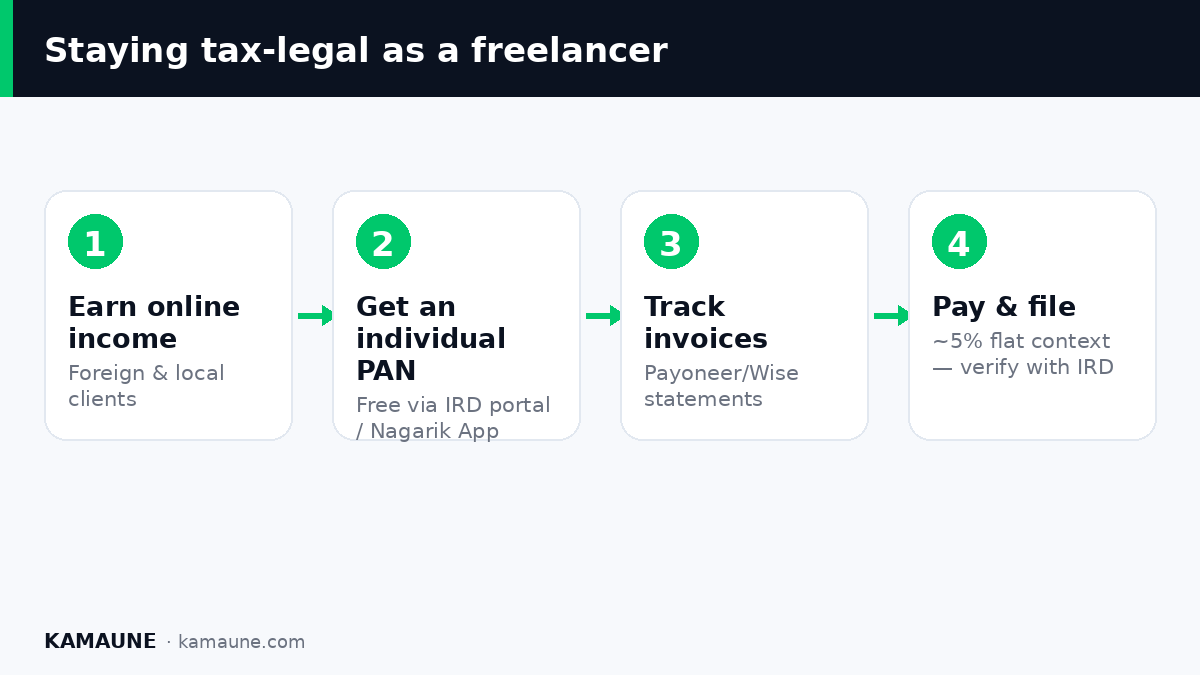
For most freelancers starting out, an individual PAN (Permanent Account Number) is enough to operate properly. You don't need to register a company on day one.
As of 2026:
- It's free to obtain a PAN.
- You can apply online through the Inland Revenue Department (IRD) portal, or via the Nagarik App.
- It typically takes around 3–5 working days to be issued.
You'll generally need your citizenship details and basic personal information. Verify the current process, documents, and timelines with the IRD, since online government processes are updated periodically.
Getting a PAN also makes the rest of your freelancing cleaner — it's what your bank and payment providers expect, and it's the anchor for filing.
The flat tax on freelance / foreign service income
Here's the number people search for. As of 2026, a roughly 5% flat tax context applies to freelance/foreign service income under the framework of the Income Tax Act 2058. It's meant to be simple relative to the regular progressive salary slabs.
Two honest caveats:
- The exact rate, any thresholds, and how it's applied can change, and the specifics of your situation matter. Treat "~5%" as a 2026 snapshot, not a permanent guarantee.
- Verify the current rate and threshold with the IRD or a qualified tax professional before you file or plan around it.
The point isn't to memorize a percentage — it's to know that a modest, manageable tax applies, and that ignoring it is the expensive choice.
When to move from individual PAN to a registered firm
An individual PAN covers a solo freelancer well at the start. You should think about registering a sole proprietorship (private firm) when:
- Your income becomes consistent and larger, not occasional.
- You want to bill as a business, hire, or work with clients who require a registered vendor.
- You cross thresholds where formal registration or VAT becomes relevant.
At that stage, the process, costs, and when VAT kicks in are covered in how to register a business in Nepal. Don't rush into it before you need it — but don't cling to an individual PAN once you've clearly outgrown it.
Record-keeping: the habit that saves you
Tax trouble for freelancers is almost always a records problem, not a rate problem. Build one simple habit from your first payment:
- Keep your Payoneer and Wise statements — they show what came in and when. (See how to get paid as a freelancer in Nepal for the payment setup itself.)
- Save invoices you send clients and any platform earnings reports (Fiverr/Upwork).
- Note which currency and the date, so you can reconcile to your bank deposits.
- Keep it all in one folder — a spreadsheet plus PDFs is plenty.
When it's time to file, or if your bank asks questions, this folder answers everything in minutes instead of days.
A simple first-year checklist for freelancers
If you're just starting to earn, this is the practical order of operations to stay on the right side of the rules without over-complicating things:
- Get an individual PAN through the IRD portal or Nagarik App as soon as your income starts becoming real (free, ~3–5 working days).
- Open or confirm a Nepali bank account in your legal name, with KYC complete, so foreign payments land cleanly. See how to get paid as a freelancer in Nepal.
- Keep every statement and invoice from month one — Payoneer/Wise records, platform earnings, and the invoices you send.
- Note your total income as it accumulates so nothing is a surprise at filing time.
- Confirm the current rate, threshold, and filing steps with the IRD or a tax professional before you file.
- Reassess yearly: if income has become consistent and larger, look at registering a firm via how to register a business in Nepal.
None of these steps is expensive or slow on its own. Doing them in order, early, is what keeps a growing freelance income from turning into a compliance headache later.
Disclaimer
This article is educational, not financial or legal advice. Rules, rates, and fees change — verify with the relevant official source or a qualified professional before acting.
Tax rates, thresholds, and registration processes in Nepal are updated over time. Everything above is a 2026 snapshot; confirm current figures and requirements directly with the Inland Revenue Department or a licensed tax professional before you file or make decisions.
Frequently Asked Questions
Do freelancers pay tax in Nepal?
Yes. Freelancing income — including money earned from foreign clients — is taxable in Nepal under the Income Tax Act 2058. For most solo freelancers, getting an individual PAN and paying the applicable flat tax keeps you compliant. Verify current rules with the IRD.
Is PAN registration free in Nepal?
Yes. As of 2026, obtaining an individual PAN is free, and you can apply through the IRD online portal or the Nagarik App, usually within about 3–5 working days. Confirm the current process and documents on the IRD site.
When must I register a business instead of using an individual PAN?
Consider registering a sole proprietorship once your freelance income is consistent and larger, when you need to bill as a formal business, or when you cross thresholds where registration or VAT applies. See how to register a business in Nepal for the process, and confirm thresholds with the IRD.
Is foreign income taxed for freelancers in Nepal?
Yes — foreign-sourced freelance income earned by a resident is taxable in Nepal. Keep your Payoneer/Wise statements and invoices as proof, and verify the current rate and any threshold with the IRD or a tax professional.
Conclusion
Staying legal as a Nepali freelancer is cheaper and simpler than most people fear: your income is taxable, an individual PAN (free, a few working days) is usually enough to start, a modest flat tax context of around 5% applies as of 2026, and you register a firm only once you've clearly outgrown solo status. The one habit that saves you is keeping your payment statements and invoices from day one — and verifying every figure with the IRD before you file.
Handle the tax, then look after the money you keep. A natural next step is building a system around it: personal finance in Nepal. For the full earning path, the freelancing guide and the pillar guide to earning online in Nepal tie everything together.
Get clear, Nepal-specific money and tax explainers — join the Kamaune newsletter.