Most "30 business ideas in Nepal" lists are useless in the same way: they name a business, slap on a made-up "investment: 5 lakh" figure, and never mention the two things that actually decide whether you start — how much cash you truly need on day one, and whether you have the skill or the time to run it. This guide is built the opposite way. The ideas are grouped by the capital they realistically need, each one tagged with the skill and the kind of person it suits, and the hard parts (registration, getting paid, competition) are named instead of hidden.
Plenty of small businesses in Nepal have started from a phone, a Facebook page, and NPR 50,000 or less — a home kitchen selling momos to an office block, a reseller flipping clothes on Instagram, a student running a tuition batch. Others need a shutter and a lakh or two. Both are covered below. What none of them are is "passive" or "guaranteed." Pick based on what you can actually sustain for six months before it pays off.
How to pick an idea (before you look at the list)
Three filters, in order:
- Capital you can afford to lose. Not your total savings — the amount you can put in and still eat if it fails. Start at the bottom of the range and scale only once something works.
- A skill or interest you already have. A business you understand from the inside (you cook, you shoot video, you know a product category) beats a "hot" idea you'd have to learn from zero while also learning to run a business.
- Real demand near you. "Profitable in Nepal" means nothing in the abstract. Is there demand on your street, in your college, in your Facebook groups, in your city — Kathmandu, Pokhara, Butwal, Chitwan — for this specific thing? Ask ten potential customers before you spend a rupee.
A useful sanity check: if the idea needs a big loan, a shop lease, and staff before it earns a single rupee, it is not a "low-investment" business — it's a bet. The ideas below are designed so you can test demand cheaply first.
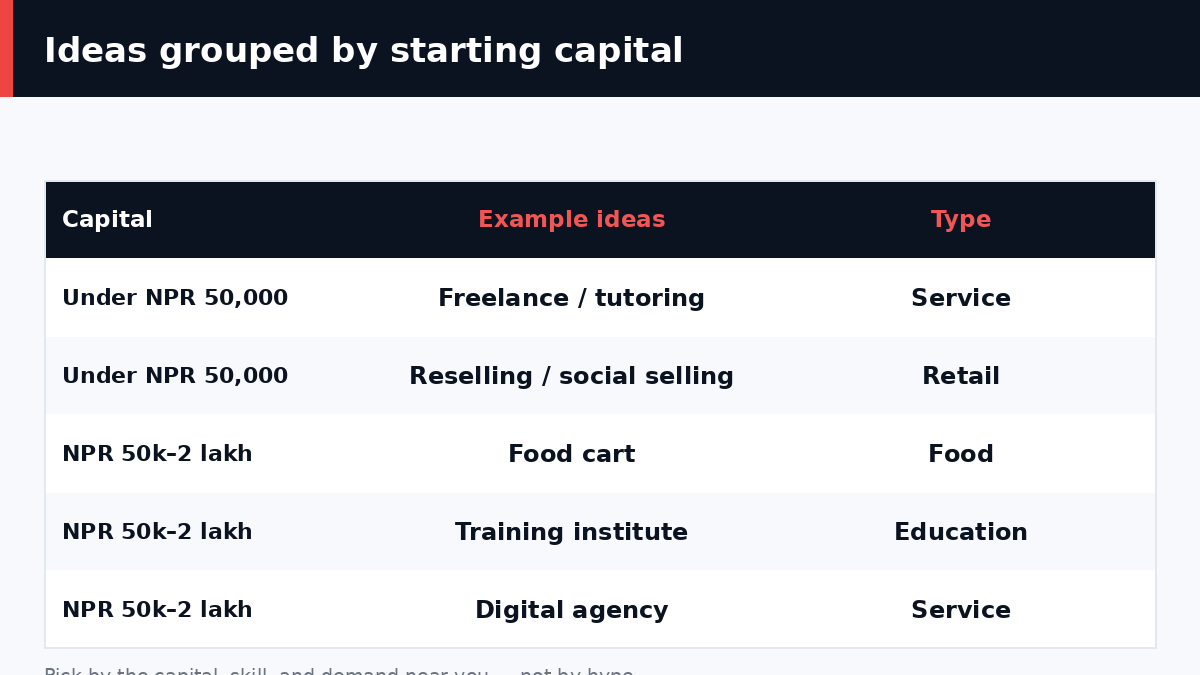
Ideas under ~NPR 50,000 (start from home, phone, or a page)
These need mostly time, a skill, and a small amount of stock or equipment. Many run entirely from a home, a mobile, and a social media page.
| Idea | Rough capital (NPR) | Skill needed | Who it suits |
|---|---|---|---|
| Freelancing / digital services (design, writing, dev, video editing) | Under 10,000 (a laptop you likely own) | The skill itself | Anyone with a marketable skill; students |
| Home tuition / test-prep batch | Under 10,000 | Subject knowledge + patience | Students, teachers, recent graduates |
| Online tutoring / skill course | 10,000–30,000 (mic, decent internet) | Teaching + a topic people pay to learn | Confident explainers |
| Social-commerce reselling (clothes, cosmetics, accessories) | 20,000–50,000 (initial stock) | Sourcing + basic marketing | Sellers who enjoy chatting with buyers |
| Home food cart / cloud kitchen (momos, snacks, tiffin) | 30,000–50,000 | Cooking + hygiene discipline | People who genuinely cook well |
| Content & social media management for small businesses | Under 15,000 | Writing, design, posting | Social-media-fluent students/creators |
| Digital marketing (managing ads/pages for local shops) | Under 20,000 | Ads, analytics, communication | Marketers, self-taught learners |
A few honest notes on this tier:
- Freelancing and digital services are the lowest-risk entry point in this whole list, because the "capital" is a laptop and a skill, not stock that can go unsold. If that's your path, the natural next question is getting paid by clients abroad — covered below.
- Reselling looks easy and is crowded. Your edge is either a product nobody else is selling in your area, or genuinely better service (faster replies, honest sizing, no-fuss returns). Buying a lot of stock upfront is the classic beginner mistake — start with a small batch you can clear.
- Food is the highest-demand, hardest-discipline option here. The margins are real, but so are the hygiene and consistency requirements. Test with a handful of regular customers before scaling.
Ideas NPR 50,000–2 lakh (a small shop, an agency, an institute)
More capital, usually because there's inventory, equipment, or a small space involved. Demand tends to be steadier, but so is the overhead.
| Idea | Rough capital (NPR) | Skill needed | Who it suits |
|---|---|---|---|
| Digital marketing agency (2–3 clients, then grow) | 50,000–1 lakh | Marketing + client management | Freelancers ready to build a team |
| Training institute (language, IT, skills — can run online) | 75,000–2 lakh | Teaching + a curriculum | Educators, subject experts |
| Small retail / grocery / stationery corner | 1–2 lakh | Stock management + local relationships | People in a good foot-traffic spot |
| Café / tea-and-snack counter (small) | 1.5–2 lakh+ | Food + service + location sense | Hospitality-minded operators |
| Printing / photocopy / photo services (near a college or office) | 1–2 lakh | Basic tech + reliability | Detail-oriented owners |
| Beauty / grooming services (home-based first) | 50,000–1.5 lakh | The trade + trust-building | Trained beauticians/barbers |
The pattern here: the ones you can start online or from home first — an agency, a training institute, home-based beauty services — let you prove demand before you sign a lease. The ones that need a physical spot (retail, café) put your money at risk before you've seen a single customer, so location research matters more than the idea itself.
If you're leaning toward an agency or a service business built on a skill you already sell, the natural progression is: freelance solo → get consistent clients → register and hire. That registration step is covered below.
Online-first businesses (lowest overhead, real frictions)
Nepal's internet economy is growing, and an online-first business skips rent and can reach the whole country. But there are Nepal-specific frictions you must plan around — payments and delivery especially.
- Digital agency / services: sell design, marketing, web, or video to businesses. Almost no capital, scales with your reputation.
- Content and social-commerce: build an audience, then sell products or services to it. This overlaps with creator income — see how to earn from YouTube and blogging in Nepal.
- Dropshipping and online stores: possible, but be honest about the frictions — customs on imported goods, unreliable last-mile delivery, and a cash-on-delivery culture that ties up your money and inflates returns. We cover what actually works in how to start an online business in Nepal.
For any online business, sort out payments early. Local customers can pay you via wallets and QR — see our comparison of the best digital wallets in Nepal. If you'll sell to clients abroad, note that PayPal can't receive money into Nepal; read how freelancers and businesses in Nepal get paid for the Payoneer/Wise route.
Turning a side hustle into a business
Most Nepali small businesses don't start as "businesses." They start as a side hustle — a few tuition students, a weekend baking order, a Fiverr gig — that grew. That's the smart, low-risk path: you test demand on someone else's time and money before you commit.
If you're a student or someone with a full-time job looking to start small, the ideas in side hustle ideas for students in Nepal are chosen specifically for low time and low capital. The moment a side hustle earns consistent, meaningful income, treat it like a business — which mostly means the next section.
The boring-but-critical part: registration, PAN, and tax
This is where enthusiasm dies and where most "business ideas" articles go silent. Here's the honest version.
- You generally need a business PAN to operate formally, invoice clients, and stay on the right side of the Income Tax Act 2058. PAN registration is free through the IRD online portal / Nagarik App and typically takes a few working days (verify the current process with the Inland Revenue Department before acting).
- A sole proprietorship — a "private firm" — is the simplest structure for one owner. Registration usually costs somewhere in the low thousands of rupees depending on the type of business and any licenses (as of 2026; verify current fees).
- If you're freelancing solo, an individual PAN is often enough to start — you register a firm when income becomes consistent and significant.
Don't skip this because it feels intimidating. The full walkthrough — structures, documents, cost, PAN, and when VAT applies — is in how to register a business in Nepal (sole proprietorship + PAN).
Getting paid (local and foreign customers)
A business only counts once money reaches your account.
- Local customers: digital wallets (eSewa, Khalti, IME Pay) and ConnectIPS/QR cover most everyday payments. Compare them in the best digital wallet in Nepal guide.
- Foreign clients: you cannot receive into PayPal in Nepal. Use Payoneer or Wise, then withdraw to your Nepali bank — see how to get paid from abroad in Nepal.
One more framing that helps: a low-investment business is itself a form of investment — of your money, but mostly of your effort and time. If you're weighing whether to put savings into a business versus other options, our guide to the best investment options in Nepal puts business alongside FDs, shares, and gold so you can compare honestly.
Worked example: a NPR 40,000 reselling start
Say you start social-commerce reselling with NPR 40,000. A realistic first-month split might be: NPR 30,000 on an initial, deliberately small stock of one product line; NPR 5,000 on packaging and delivery; NPR 5,000 held back for boosting a few posts and for the returns you will get under COD. You don't rent anything, you run it from your phone, and you register a PAN once orders are steady. The point isn't the exact figures — it's that you keep a buffer, buy small, and prove people will actually pay before you scale the stock. That discipline is what separates a business from a pile of unsold inventory.
Frequently Asked Questions
What is the best low-investment business in Nepal?
There's no single "best" — it depends on your skill and time. If you have a marketable skill and a laptop, freelancing or digital services is the lowest-risk start because you're not buying stock. If you cook well, a home food cart has strong demand. Match the idea to what you can sustain, not to what sounds trendy.
Do I need to register a small business in Nepal?
To operate formally, invoice, and pay tax correctly, yes — you generally need at least a business PAN, and a private-firm registration for a sole proprietorship. A solo freelancer can often start with an individual PAN. See our business registration guide for the process, cost, and when VAT applies (verify current rules with the IRD).
What are good business ideas for students in Nepal?
Low-time, low-capital ones: tutoring, freelancing, content/social media management, and reselling. We've collected fifteen chosen specifically for student schedules and budgets in side hustle ideas for students in Nepal.
Which business is most profitable in Nepal?
Profitability depends on execution, location, and demand far more than on the category. A well-run home food business can out-earn a poorly located retail shop. Rather than chasing "most profitable," pick something with real demand near you that you can run consistently, then improve margins as you learn.
Conclusion
Starting small in Nepal is less about finding a secret idea and more about matching a realistic idea to your capital, skill, and local demand — then testing it cheaply before you scale. Begin at the bottom of the capital range, prove people will pay, register properly once income is steady, and get your payments sorted early. That's the whole playbook.
Pick one idea from the tier you can actually afford, and take the first concrete step this week.
Ready to make it official? Here's how to register your business and get a PAN in Nepal. And to get one practical, tested money idea for Nepal each week, join the Kamaune newsletter.