Your salary hits the bank on the last day of the month. By the second week, a chunk has gone to rent and dashain-loan repayments; by the third week you are checking your eSewa balance before ordering khaja. Then someone in the family needs money urgently, and the "savings" you meant to keep never left the account. Next month, the same loop.
This is the most common money problem in Nepal, and it has almost nothing to do with how much you earn. People on NPR 30,000 and people on NPR 90,000 both run out — because managing money is a system, not a salary number. This guide gives you that system: a plain order of operations you can run every month, built for how money actually moves in Nepal (cash, wallets, family obligations, and all). No slogans, no "invest in yourself" filler.
The money order of operations
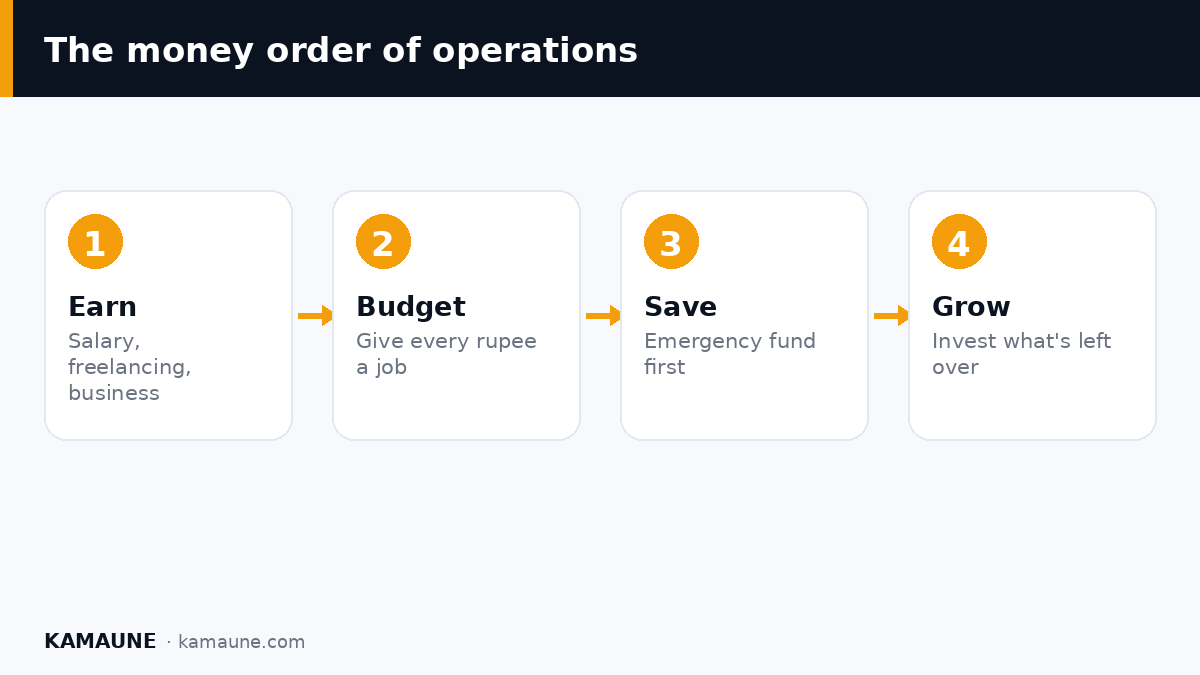
Most financial advice fails because it hands you the last step first — "invest in the share market!" — before the earlier steps are in place. Do it in order and each step makes the next one easier:
- Earn — your income, from a job, freelancing, or a business.
- Budget — decide where the money goes before it disappears.
- Save — build a cushion so one emergency doesn't wipe you out.
- Protect — insurance and staying out of high-interest debt.
- Grow — only once 1–4 are steady, put surplus into investments.
If you skip to step 5 without step 3, one hospital bill or lost job forces you to sell investments at the worst time. Steps in order beats steps out of order, every time. If your problem is that step 1 is too small, that is a real constraint — our guide to earning money online in Nepal covers ways to add income — but even a bigger income leaks out the same holes until steps 2 through 4 are fixed.
Budgeting: the fastest way to control money
A budget is not about restricting yourself. It is about deciding on payday where your money goes, so you are not guessing on the 20th. The simplest starting frame is the 50/30/20 rule — roughly half your take-home to needs, a third to wants, and a fifth to savings — adjusted for local reality (family support, irregular income, a cash-heavy economy).
Here is that split on a common salary:
| Category | Share | On NPR 40,000/month |
|---|---|---|
| Needs (rent, food, utilities, transport, minimum loan payments) | 50% | NPR 20,000 |
| Wants (eating out, subscriptions, outings, gadgets) | 30% | NPR 12,000 |
| Savings & debt payoff (emergency fund, investments, extra loan payments) | 20% | NPR 8,000 |
Treat these as targets, not laws. In Nepal, "needs" often includes money sent to parents, and rent in Kathmandu can eat far more than 50% — in which case you trim "wants," not savings. The full method, including how to track a month of spending and budget when income is irregular, is in our dedicated walkthrough on how to make a budget in Nepal.
Two habits make a budget actually stick here. First, track spending across all three places money lives — cash, digital wallets, and your bank account — because in Nepal a huge share of daily spending is cash and small wallet taps that never show on a statement. Second, plan for the lumpy costs that wreck monthly budgets: Dashain and Tihar, the wedding season, annual school fees, insurance renewals. Set aside a little every month for these "sinking funds" so a festival or a wedding invitation doesn't blow up a single month and send you back to borrowing.
Where to keep money and how to pay
You need two layers: a bank account for holding money and receiving salary, and a digital wallet for daily payments. They do different jobs.
- Bank account (and fixed deposits): where your salary lands and where savings and larger balances live. Money is safer here, and a fixed deposit earns interest a wallet cannot match.
- Digital wallet (eSewa, Khalti, IME Pay, ConnectIPS): for topping up mobile, paying bills, QR payments at shops, and small transfers. Fast and convenient — but not a savings account.
A rule worth burning into memory: do not park large sums in a wallet. Keep only what you will spend in the next week or two; the rest belongs in a bank or fixed deposit where it is safer and can earn. To pick the wallet that fits how you actually pay, see our comparison of the best digital wallets in Nepal.
Building a safety net
Before you invest a single rupee, you need an emergency fund — money set aside only for genuine emergencies (job loss, medical bills, urgent family need). The standard target is 3 to 6 months of your essential expenses, kept somewhere liquid so you can reach it fast.
Why this comes before investing: without a cushion, the first emergency forces you to borrow at high interest or sell investments at a loss. The emergency fund is what lets everything else stay invested. If you spend NPR 25,000 a month on essentials, a starter fund is NPR 75,000 (three months) and a fuller one is NPR 150,000 (six months). Building it slowly is fine — the full method is in our guide on how to save money and build an emergency fund in Nepal.
Growing money — an honest map of options
Once your budget holds and your emergency fund is in place, the surplus can go to work. There is no single "best" investment — each option trades off risk, return, how much you need to start, and how quickly you can get your money back.
- Fixed deposits and savings — safest, predictable, lowest return.
- Shares / NEPSE — higher potential return, real risk of loss, needs a demat account.
- Mutual funds — a hands-off way into the market, managed for you.
- Gold and real estate — traditional Nepali stores of value, but not very liquid.
The right mix depends on your goals and how long you can leave the money — this is the single most useful question in investing. Money you'll need within a year should stay safe and liquid (savings, short-term FD); money you can leave untouched for five years or more can take on the higher risk of shares or mutual funds, because time smooths out the bumps. Matching each rupee to when you'll need it matters far more than chasing the highest-return option. For a full risk-versus-return breakdown of every option, read our guide to the best investment options in Nepal. If shares interest you specifically, start with how to invest in the share market in Nepal, which walks through the accounts and steps you need.
One warning that belongs here: any scheme promising to "double your money" in months, or "guaranteed" high returns, is a red flag. Legitimate investing does not work that way.
Protecting what you've built
Step four — protection — is the one people skip until it's too late, and it's what separates a temporary setback from a financial disaster. Two things do most of the work: insurance and staying out of high-interest debt.
Insurance transfers a risk you can't afford onto someone who can. A single serious illness or accident can wipe out years of saving in one hospital stay. Health insurance and, if people depend on your income, term life insurance are the two that matter most for a typical earner in Nepal. Employer coverage, if you have it, is a start — but check what it actually covers before assuming you're protected. The point of insurance isn't to profit; it's to make sure one bad event doesn't undo everything in steps two and three.
Protecting your cash flow matters just as much. That means keeping your emergency fund intact (don't raid it for wants), not co-signing loans you can't afford to repay yourself, and being honest about money lent to family. A plan that ignores these risks is only a plan for the months when nothing goes wrong — and something always eventually does.
Managing debt and avoiding money traps
Debt is not automatically bad — a loan for education or a productive asset can pay off. High-interest consumer debt is the trap. A few Nepal-specific dangers to watch:
- Instant-loan and quick-cash apps — many charge punishing interest and fees, and some harvest your contacts and harass you. Read the terms; prefer a bank or cooperative.
- Buying on credit for wants — financing a phone or gadget you can't afford in cash quietly eats future income.
- "Double your money" and unregistered investment schemes — treat any guaranteed high return as a scam until proven otherwise.
- Lending to family without a plan — common in Nepal; be honest with yourself about whether it is a gift, because it often becomes one.
Pay down the highest-interest debt first while keeping minimum payments on the rest. Clearing a 30%+ interest loan is effectively a 30% guaranteed return — better than almost any investment.
A one-page personal finance plan
You do not need a spreadsheet with fifty rows. On payday, run this checklist:
- Income in — confirm salary/earnings landed in your bank.
- Pay yourself first — move your savings amount (aim for ~20%) out before spending anything.
- Cover needs — rent, utilities, food, transport, minimum loan payments.
- Fund the emergency account — until it holds 3–6 months of expenses.
- Allow wants — a set amount for enjoyment, so the plan is livable.
- Grow the surplus — once the fund is full, direct extra into investments.
- Review monthly — did it match reality? Adjust next month's numbers.
Run this for three months and the "salary gone by week three" loop breaks — not because you earned more, but because you decided where the money went before it decided for you. Tax fits into this picture too: if you earn from freelancing or a business, set aside money for it as you go — see tax for freelancers in Nepal for how that works.
Frequently Asked Questions
How do I start managing money with a low salary?
Start with the order of operations, not the amount. Even on a small salary, move a fixed slice — say 10% — into savings the day you get paid, before spending. Track one month to see where money actually leaks. Managing well on a low salary is what builds the habit that handles a bigger one later.
How much should I save each month?
A common target is 20% of take-home pay, but the right number is whatever you can keep consistently. If 20% is impossible after rent and family support, start at 5–10% and raise it as income grows. Consistency matters more than the percentage.
What's the best place to keep my savings in Nepal?
For money you might need soon (your emergency fund), a liquid savings account is best. For money you can lock away, a fixed deposit earns more. For money you want to grow over years, see the best investment options in Nepal. Avoid keeping large balances in a digital wallet.
Do I need to understand the share market to be good with money?
No. Budgeting, saving, avoiding high-interest debt, and building an emergency fund are the foundation, and they don't require any investing knowledge. The share market is only step five — useful once the basics are solid, optional if it isn't for you.
Conclusion
Good personal finance in Nepal is not about a secret investment or a big income. It is a repeatable monthly system: earn, budget, save, protect, then grow — in that order. Nail the first four and the fifth takes care of itself over time. Start this month with just one step — moving your savings out on payday before you spend — and build from there.
Start with a budget that survives Nepal's cash habits — read our step-by-step guide to making a budget in Nepal, and join the Kamaune newsletter for one practical money habit each week.