Leave NPR 100,000 in a regular savings account for a year and you'll have a little more than NPR 100,000. But the price of daal, rent, and a plate of momo will have gone up by more than the interest you earned. In real terms — what your money can actually buy — you'll be poorer. That's the quiet problem with "just saving": inflation eats idle money, and a low-interest savings account barely fights back.
Growing money means putting it somewhere it can outpace inflation — and every one of those places trades safety for return. There is no option that is safe, high-return, and instantly accessible all at once; anyone who tells you otherwise is selling something. This guide maps Nepal's real options honestly, so you can match each one to your goal and your stomach for risk.
First, one non-negotiable: don't invest money you might need soon. Build your emergency fund of 3–6 months' expenses first, kept liquid. Investing is for the surplus after that cushion exists — otherwise the first emergency forces you to sell at the worst possible time. Growing money is the last step in managing your money in Nepal; the earlier steps come first.
The option map at a glance
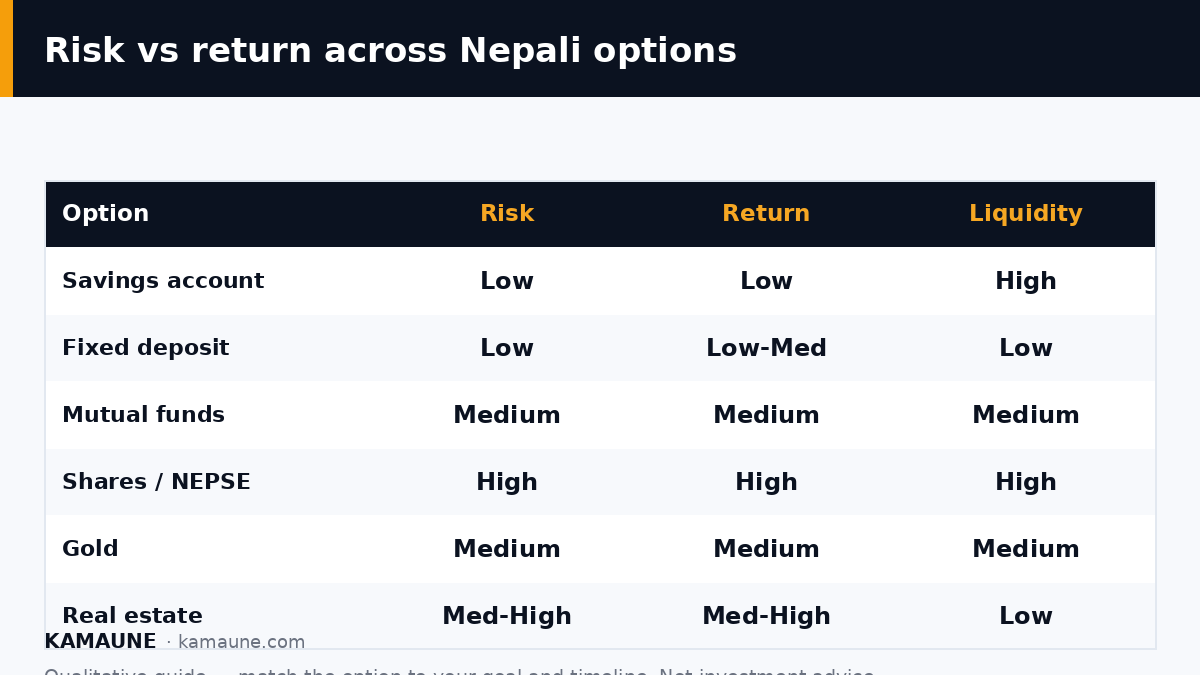
| Option | Typical risk | Typical return | Minimum to start | Liquidity (how fast to cash) |
|---|---|---|---|---|
| Savings account | Very low | Very low | Almost nothing | Instant |
| Fixed deposit (FD) | Very low | Low, fixed & predictable | A few thousand NPR | Locked for the term (penalty to break) |
| Mutual funds | Medium | Medium (market-linked) | Low (small units) | Moderate (open-end: redeem; closed-end: sell on NEPSE) |
| Shares / NEPSE | High | High (and can be negative) | ~NPR 1,000 (an IPO lot) | Moderate (sell on market, T+ settlement) |
| Gold | Medium | Varies with global price | Cost of a few grams | Moderate (sell to a dealer) |
| Real estate | Medium–high (illiquid) | Can be high over years | Very high (lakhs+) | Very low (months to sell) |
Read this table as a spectrum, not a ranking. The "best" option is the one that fits how long you can leave the money and how much loss you can tolerate. Returns shown are general tendencies, not promises — verify current rates and terms with the bank, fund manager, or NRB/SEBON before acting.
Fixed deposits and savings — the safe base
A savings account is where your emergency fund and short-term money should sit: instant access, near-zero risk, and a small interest rate. Its job is safety and liquidity, not growth.
A fixed deposit (FD) locks a sum for a fixed term (say 1–5 years) at a rate agreed upfront. Because you commit the money, the rate is higher than a savings account — and it's predictable, which is exactly why risk-averse savers love it. The trade-off: break it early and you'll usually forfeit some interest as a penalty. FD rates change with the market and differ between banks, so check current rates with the bank and against Nepal Rastra Bank guidance before choosing; don't rely on a rate you saw quoted online months ago. FDs are ideal for money you want to grow safely but won't need for a year or more.
Shares / NEPSE — higher risk, higher potential return
Buying shares on NEPSE means owning a slice of a listed company, earning through dividends and price gains. The upside is real — over the long run, shares have historically outpaced FDs — but so is the downside: prices fall, and a bad company or a bad market can lose you money. Shares suit money you can leave invested for years and won't panic-sell in a dip.
You'll need a bank account, a demat account, MeroShare, and a broker to start. The full beginner roadmap is in our guide on how to invest in the share market in Nepal, and the setup steps are in how to open a demat and MeroShare account. One more thing new investors forget: profits are taxed. Before you sell, understand the capital gains and dividend tax on shares in Nepal so the tax deduction isn't a surprise.
Mutual funds — a hands-off way into the market
If shares appeal but picking individual companies feels overwhelming, a mutual fund pools money from many investors and a professional fund manager invests it across a basket of shares and other assets. You get market exposure and diversification without doing the stock-picking yourself, often starting with a small amount.
Funds come in two flavours in Nepal: closed-end funds (a fixed pool listed and traded on NEPSE like a share) and open-end funds (you buy and redeem units directly with the fund at its net asset value). Returns are market-linked — better than an FD in good years, and they can fall in bad ones. Mutual funds are a sensible middle step for beginners who want to be in the market but not manage it daily.
Gold and real estate — traditional Nepali stores of value
Gold has been Nepal's default store of value for generations. It holds purchasing power over the long term and is easy to buy, but its price swings with the global market, it earns nothing while you hold it (no interest or dividend), and physical gold carries making charges and storage risk. Treat it as a hedge, not a growth engine.
Real estate — land and property — has built a lot of Nepali wealth, and over long horizons it can return well. But it demands serious capital (lakhs and up), is very illiquid (selling can take months), and carries costs like registration and taxes. It suits people with large surpluses and a long time frame, not someone taking their first step beyond a savings account.
Matching the option to your goal
Pick by when you need the money, not by which return looks biggest:
- Money you might need this year (emergency fund): savings account — see how to build an emergency fund in Nepal. Never in shares.
- 1–3 years, safety first: fixed deposit.
- 5+ years, comfortable with ups and downs: shares and/or mutual funds.
- Long-term hedge or store of value: gold, or real estate if you have the capital.
A common sensible pattern: emergency fund in savings, medium-term money in an FD, and long-term surplus split between mutual funds and shares. Diversifying across options lowers the chance that one bad year wrecks everything.
Scams to avoid
Nepal, like everywhere, has schemes that prey on the wish for fast, safe, high returns. Protect yourself with a few hard rules:
- "Guaranteed" or "double your money" schemes are scams. No legitimate investment guarantees a high return, and none doubles your money quickly and safely. This includes many "network"/MLM and unregistered online "investment apps."
- If it isn't registered, don't invest. Shares, mutual funds, and licensed FDs are overseen by regulators like SEBON and Nepal Rastra Bank. Unregistered schemes have no such protection — and no recourse when they vanish.
- Pressure and secrecy are red flags. "Invest today, the offer closes tonight," or "don't tell anyone about this" — walk away.
- Understand it before you fund it. If you can't explain how an investment actually makes money, you're not investing, you're gambling on someone's word.
Frequently Asked Questions
What's the safest investment in Nepal?
Bank savings accounts and fixed deposits are the safest, with very low risk and predictable, if modest, returns. Fixed deposits pay more than savings because you lock the money for a term. Neither will make you rich, but they won't lose your capital either — ideal for money you can't afford to risk.
What's the best investment for small amounts?
With a small amount, mutual funds and IPO shares (from around NPR 1,000 for a lot) let you start without much capital, and a fixed deposit works too. The habit of investing regularly matters more than the size of each contribution. Just make sure your emergency fund exists before you invest anything.
Fixed deposit vs shares — which is better?
They serve different goals. An FD is safe, predictable, and best for money you'll need within a few years. Shares carry real risk of loss but higher long-term return potential, suiting money you can leave for 5+ years. Many people use both — an FD for safety and shares for growth.
Are mutual funds good for beginners?
Yes — mutual funds are one of the better starting points because a professional manager diversifies your money across many assets, so you're not betting on one company. Returns are market-linked (they can fall in bad years), but the risk is spread. They're a natural middle step between a fixed deposit and picking your own shares.
Conclusion
There is no single best investment in Nepal — only the option that fits your goal, your time frame, and your tolerance for risk. Build your emergency fund first, keep safe money in savings and FDs, and put long-term surplus into shares, mutual funds, gold, or property as your comfort grows. Diversify, ignore anything "guaranteed," and start small — the habit matters more than the amount.
This article is educational, not financial or legal advice. Rules, rates, and fees change — verify with the relevant official source (such as Nepal Rastra Bank or SEBON) or a qualified professional before acting.
Ready for the market? Start with our beginner's roadmap on how to invest in the share market in Nepal, and join the Kamaune newsletter for honest money guidance every week.