Ask ten people in Nepal which digital wallet is best and you'll get one answer ten times: "whichever one my friends use." That's how most of us ended up with eSewa or Khalti — not because we compared them, but because that's what the momo shop had a QR sticker for. It works, mostly. But if you've ever been stuck because a bill only accepts one wallet, or wondered whether the balance sitting in your app could be earning something, it's worth actually choosing rather than defaulting.
Nepal has four names that matter: eSewa, Khalti, IME Pay, and ConnectIPS. They overlap, but each is genuinely better at something. This is a side-by-side look at what each one is for, so you can pick based on how you pay and save — not on what your neighbour tapped last week. Figures here are a 2026 snapshot; verify current fees, limits, and features on each provider's own site before you rely on them.
The big four at a glance
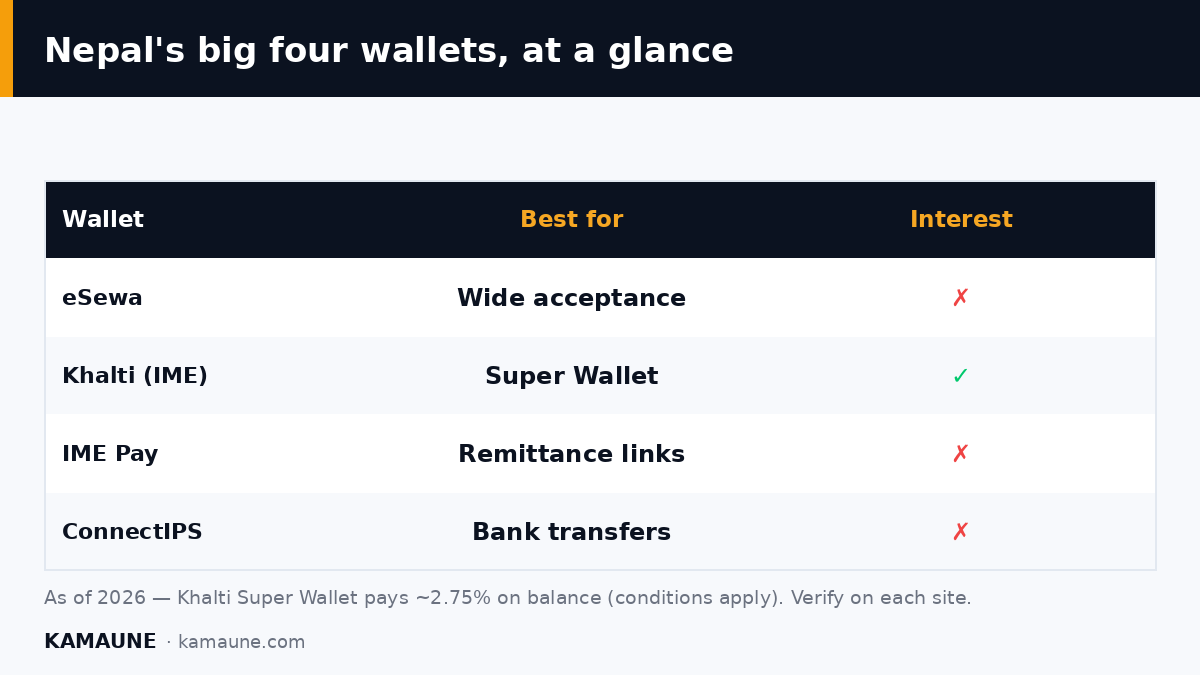
| Wallet | Best for | How to load | KYC | Notable feature |
|---|---|---|---|---|
| eSewa | Widest acceptance, everyday bills & QR | Bank transfer, mobile/internet banking, connectIPS, cards, bank deposit, cash points | Required for full limits | Oldest wallet; accepted almost everywhere |
| Khalti | Bills, QR, and earning interest on balance | Bank/internet banking, cards, connectIPS, bank deposit, 40+ banks supported | Required for full limits & Super Wallet | Super Wallet pays interest on your balance (2026) |
| IME Pay | Remittance-linked users, bill payments | Bank transfer, banking apps, connectIPS, agents | Required for full limits | Ties in with IME's remittance network |
| ConnectIPS | Larger bank-to-bank transfers | Directly linked to your bank account(s) | Bank-verified | Move bigger amounts between banks cheaply |
The rest of this guide explains what sits behind each row. Note the pattern: the first three are wallets (you load money in, then spend), while ConnectIPS is really a bank-to-bank transfer rail — a different tool for a different job.
eSewa — the oldest and most widely accepted
eSewa was Nepal's first mover in digital payments, and that head start shows: it's the wallet most likely to be accepted wherever you go, from the big utility billers to the small shop with a printed QR. If you want one wallet that "just works" for topping up mobile, paying electricity and internet bills, buying bus/flight tickets, and scanning to pay at shops, eSewa is the safe default.
Its strength is breadth of acceptance rather than any single standout feature. For most everyday Nepali spending, that breadth is exactly what you want. Complete KYC verification to unlock full transaction limits, and load it via bank transfer, mobile/internet banking, connectIPS, cards, bank deposit, or a physical cash point.
Khalti — and the Super Wallet interest feature
Khalti, from the IME group, covers the same everyday ground as eSewa — bills, QR payments, recharges, tickets — and it supports loading from 40+ banks via mobile/internet banking, cards, connectIPS, and bank deposit. Where it has tried to stand apart is the Super Wallet.
Launched in 2026 in partnership with Global IME Bank, the Khalti Super Wallet pays around 2.75% annual interest on your wallet balance — something a normal wallet balance never earns. As of 2026, to qualify you need to be KYC-verified and meet one of two conditions: complete at least 10 successful transactions, or keep a minimum overnight balance of NPR 1,000. Terms like the rate and qualifying conditions can change, so verify the current details on khalti.com before counting on them.
Is this a reason to switch? For small balances, the interest is modest — a few rupees on a few thousand. It's a nice bonus if Khalti is already your daily wallet, but it is not a savings strategy. Which leads to the most important point in this whole article, below.
IME Pay
IME Pay does the standard wallet jobs — bill payments, recharges, QR, transfers — and its natural advantage is its link to the IME remittance network. If your household receives remittance through IME, or you're already in that ecosystem, IME Pay can be the most convenient wallet for moving that money into everyday spending. Load it via bank transfer, banking apps, connectIPS, or agents, and complete KYC for full limits. For general daily use it's a solid third option; its edge is the remittance tie-in rather than acceptance breadth.
ConnectIPS — for bigger bank-to-bank transfers
ConnectIPS is the odd one out, and understanding why makes wallet choice much clearer. It isn't really a "load money and spend" wallet — it links directly to your actual bank account(s) and moves money bank to bank. That makes it the tool of choice when you need to transfer a larger amount (paying a big bill, sending money to another person's bank account, funding an investment) rather than tap-to-pay at a shop.
For everyday QR payments and recharges, a wallet like eSewa or Khalti is smoother. For moving real money between banks without wallet limits getting in the way, ConnectIPS is what you want. Many people use both: a wallet for daily spends, ConnectIPS for the occasional big transfer.
Which should you use?
Match the tool to the job rather than looking for one winner:
- Everyday bills, recharges, QR at shops: eSewa (widest acceptance) or Khalti — pick whichever your regular billers and shops accept.
- You want your daily balance to earn a little: Khalti with the Super Wallet, if you meet the conditions.
- Your family receives IME remittance: IME Pay for the smooth handoff into spending.
- Sending a large amount between banks: ConnectIPS.
- Realistically: most people are best served by one everyday wallet plus ConnectIPS for big transfers.
Wallets vs a bank account — don't park savings in a wallet
Here's the rule that matters more than any feature comparison: a wallet is for spending money, not storing it. Even with Khalti's Super Wallet interest, a wallet balance is not the place for your savings or emergency fund. Keep only what you'll spend in the next week or two in a wallet; the rest belongs in a bank account or a fixed deposit, where it's safer and earns a meaningful return.
If your goal is to grow money rather than just spend it conveniently, a wallet is the wrong tool entirely — see our guide to the best investment options in Nepal. And if you earn from freelancing or overseas clients, once that money reaches your Nepali bank you can move it into a wallet for spending — our guide on how freelancers in Nepal get paid covers getting it into the country in the first place. Choosing a wallet is one piece of the bigger habit of managing your money in Nepal.
Frequently Asked Questions
eSewa vs Khalti — which is better?
Both cover the same everyday jobs (bills, recharges, QR, transfers). eSewa has the edge in sheer acceptance breadth as the oldest wallet; Khalti's edge is the Super Wallet interest feature (2026). Pick whichever your regular shops and billers accept, or keep both — many people do, at no cost.
Do any digital wallets pay interest in Nepal?
As of 2026, Khalti's Super Wallet pays around 2.75% annual interest on your balance, if you're KYC-verified and either complete 10 successful transactions or keep a minimum overnight balance of NPR 1,000. Verify the current rate and conditions on khalti.com. It's a small bonus, not a savings plan — a bank or fixed deposit is better for real savings.
Are digital wallets safe in Nepal?
The major wallets are regulated and widely used, and completing KYC plus using a strong PIN and app lock keeps your account reasonably secure. The bigger risk is human — phishing calls, fake "you won a prize" messages, and sharing your OTP. Never share your PIN or OTP with anyone, and don't keep large balances in a wallet.
What are the transaction limits on wallets in Nepal?
Limits depend on your KYC status (verified accounts get higher daily and monthly limits) and are set in line with Nepal Rastra Bank rules, which change over time. For amounts that hit wallet limits, use ConnectIPS for a direct bank-to-bank transfer instead. Check current limits inside each app or on the provider's site.
Conclusion
There's no single "best" digital wallet in Nepal — there's the right tool for each job. eSewa for the widest acceptance, Khalti if you want a little interest on your balance, IME Pay if you're in the remittance ecosystem, and ConnectIPS for moving larger sums between banks. Whatever you choose, remember the golden rule: a wallet is for spending, not saving.
Don't park your savings in a wallet — see where your money can actually grow in our guide to the best investment options in Nepal, and join the Kamaune newsletter for practical money tips every week.