
You can't apply for an IPO, and you can't hold a single share, until you have a Demat account and a MeroShare login. This is genuinely step one of investing in Nepal — the paperwork gate everyone passes through. The good news: you do it once, and if you get the pieces right, you never have to think about it again.
Here's exactly what a Demat account and BOID are, the documents you'll hand over, and the three-step setup — Demat, then MeroShare, then C-ASBA — so nothing blocks you later when an IPO is closing.
What a Demat account and BOID are (and where MeroShare fits)
A Demat account — from "dematerialised" — holds your shares in electronic form instead of as paper certificates. Every account is managed under CDSC (CDS and Clearing Ltd), the central depository, and comes with a unique 16-digit BOID (Beneficiary Owner Identification number). That BOID is your identity across the entire share system.
MeroShare is the online portal — meroshare.cdsc.com.np — that sits on top of your Demat account. It's where you apply for IPOs and check your portfolio. So the relationship is simple: CDSC holds your shares in the Demat account, your BOID names you, and MeroShare is the window you actually log into.
Documents you need
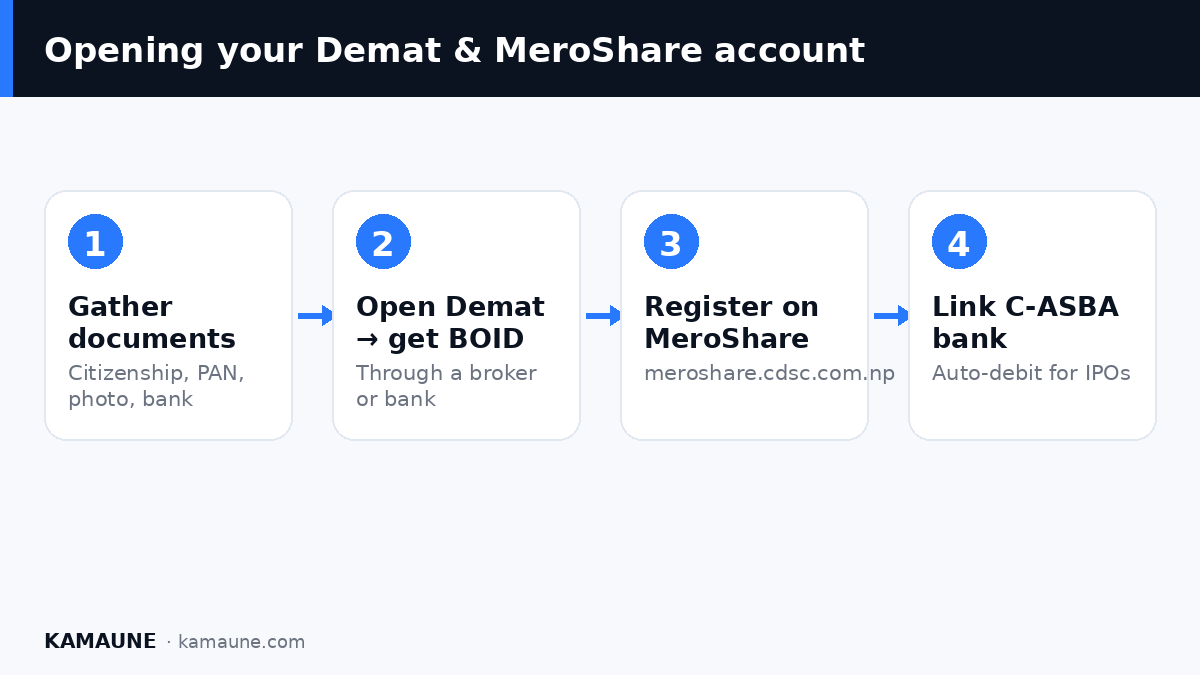
Have these ready before you go to a broker or bank branch — it makes the whole thing a single visit:
- Citizenship certificate (or passport)
- PAN card
- A recent passport-size photo
- Bank account details (account number and branch, for linking)
Requirements can vary slightly by provider, so it's worth a quick call ahead. This is a 2026 snapshot — confirm the current list with your chosen broker/bank or CDSC.
Step 1 — Open the Demat account and get your BOID
You open a Demat account through a Depository Participant (DP) — this is usually a broker or a bank that CDSC has authorised.
- Choose a DP (many people simply use the same broker they'll trade through later, to keep everything in one place).
- Fill out the Demat account opening form and submit your documents.
- Once processed, you're issued your 16-digit BOID. Write it down — you'll need it for the next step.
📷 Image to add: Demat account opening form at a broker's counter in Nepal
Step 2 — Register on MeroShare using your BOID
With your BOID in hand, register on the MeroShare portal:
- Go to meroshare.cdsc.com.np.
- Select your Depository Participant from the list.
- Enter your details, including your BOID, to create your username and password.
- Log in and confirm your account details look correct.
📷 Image to add: MeroShare registration screen showing the Depository Participant and BOID fields
Some DPs complete the MeroShare registration for you at the counter; others give you the credentials to set up yourself. Either way, once you can log in, you're most of the way there.
Step 3 — Link your C-ASBA bank account
C-ASBA (Centralised Application Supported by Blocked Amount) is what lets IPO money move automatically. When you apply for an issue, the amount is blocked in your bank account; if you're allotted, it's debited, and if you're not, it's released back to you — no manual refunds to chase.
To use it, your bank account must be linked to your MeroShare/Demat setup. Your DP or bank handles the C-ASBA registration; make sure the account you link is one you'll actually keep funded, because that's where IPO applications draw from.
Costs and annual renewal
Opening and maintaining a Demat account involves a few charges — a one-time account opening fee and a small annual renewal — and fee schedules differ between DPs. These amounts are modest but they do change, so ask your DP for their current fee sheet and check CDSC rather than relying on an old figure quoted online. As of 2026, always verify the current fees before assuming.
Common mistakes to avoid
A few small slip-ups cause most of the frustration people report when setting up:
- Mismatched names. Make sure your name reads the same across your citizenship, PAN, and bank account. Inconsistencies can hold up account opening or IPO applications.
- Linking a dormant bank account for C-ASBA. The account you link is where IPO money is blocked — if it's one you never keep funded, applications will fail. Link the account you actually use.
- Losing your credentials. Note your BOID, MeroShare username, and the DP you registered under. You'll need them for every application, and recovering them later is slower than saving them now.
- Assuming fees never change. Account opening and renewal charges are revised from time to time. Always confirm the current figure with your DP rather than trusting an old number.
- Leaving renewal lapsed. The annual renewal keeps your Demat account active. Missing it can create a scramble right when an IPO you want is open.
Getting these right the first time means the system simply works quietly in the background whenever you need it.
What's next — apply for your first IPO
Once your Demat, MeroShare, and C-ASBA are all live, you're ready for the most common entry point in Nepal: applying for an IPO. It takes a few minutes and the minimum is small. Walk through it step by step in how to apply for an IPO in Nepal.
If you also want to buy and sell shares that are already listed, you'll need a broker/trading account on top of this setup — that's covered in how to buy and sell shares in Nepal. And if you want the big-picture roadmap of how all these accounts connect, start with how to invest in the share market in Nepal.
Frequently Asked Questions
What is a BOID?
A BOID (Beneficiary Owner Identification) is the unique 16-digit number tied to your Demat account under CDSC. It identifies you across the share system and is required to register on MeroShare and apply for IPOs.
How long does it take?
Opening a Demat account and getting your BOID is usually processed within a few days of submitting complete documents, and MeroShare registration is quick once you have the BOID. Timelines vary by DP, so ask when you apply.
What's the difference between Demat and MeroShare?
The Demat account (under CDSC) actually holds your shares electronically. MeroShare is the online portal you log into to apply for IPOs and view those holdings. You need both.
Can I open it online?
Some brokers and banks offer online or app-based account opening, while others require a branch visit to verify documents. Check with your chosen DP, as this varies and changes over time.
Conclusion
The Demat and MeroShare setup is a one-time chore that unlocks everything else in the Nepali share market. Get the documents right, note your 16-digit BOID, register on MeroShare, and link a C-ASBA bank account you keep funded — and you'll never be the person scrambling to set up an account while an IPO closes.
This article is educational, not financial or legal advice. Rules, rates, and fees change — verify with the relevant official source (CDSC, NEPSE, SEBON) or a qualified professional before acting.
Want each step of investing in Nepal broken down plainly? Join the Kamaune newsletter. Next: apply for your first IPO.